We were sad to leave Nyaung Shwe, so we dragged it out as
long as we could. After our tasty Myanmar breakfast at the hotel, we rented
bicycles and rode out into the countryside, toward the mountains and away from
the lake. It was incredibly beautiful; the morning was sunny, under a blue sky,
and the breeze was cool and constant. The mountainside was velvety green, and
the roads were lined with trees. Both of us are easily lost, so we kept saying
how we needed to travel home – left, then left. Left, left, right. As was true
everywhere, the people we passed mostly paid us no mind, although many would
smile and nod, and say hello or mingalaba. We pulled over once to adjust the
height of Marc’s seat and were struggling a little with the mechanism, when a
man pulling a cart stopped, took the bike from our hands, and made the
adjustment for us without a word.
We turned down a very small road (three lefts to get back,
three lefts to get back, three lefts to get back) and passed fields and rural
homes, with people working in their gardens or tending to their homes. We saw a
sign indicating a pagoda or temple so we pedaled toward it, for a destination.
By this point we’ve seen so many pagodas, so many stupas, so many temples, but
we just didn’t want the trip to end. We stood with our bikes at the pagoda and
watched monks come and go, listened to the whine of power saws inside the
pagoda compound, smiled and nodded at
passersby, and relished the lingering. Finally, though, we had to turn back and
return to Nyaung Shwe. We’d arranged a taxi to take us to Kalaw, so we turned
in the bicycles, checked out of the wonderful little hotel, and went into the
market to find some lunch.
Marc had seen a number of stalls in the market that were
like little restaurants, and he’d also seen a tofu salad – with fried tofu –
that seemed promising, so we found a little stall and took our place on the
bench and watched the woman make our lunch. She cut the squares of fried tofu
into slivers using scissors and put them in a bowl, then topped the pile with
shredded cabbage and poured a ladle of spicy red oil over the whole mess. It
was delicious, and so spicy Marc got
hiccups and I drank a lot of water.
The cab ride from Nyaung Shwe to Kalaw was 35,000 kyats,
which is somewhere around $40, more or less. It took us about an hour and a
half, winding through the mountains, to make the trip. We didn’t have great
expectations of Kalaw; the thing to do here is to trek through the mountains to
see the small villages, or to trek to Nyaung Shwe. We’re more riders than
trekkers, so we had low expectations for our time here.
Kalaw is in the mountains, and was a hill station for the
British when it was hot; they’d come up here in the cool mountains, surrounded
by pine trees. It was always jarring to us, being in SE Asia and being surrounded
by pine trees and British colonial architecture. Our hotel seems totally
anachronistic, but it is beautiful, and set in landscaped and manicured grounds
filled with flowers and flowering trees. We’re a 20-minute walk from downtown
Kalaw, and it’s an easy downhill walk to town but a less fun uphill walk back,
so we planned to walk to town, poke around and get some dinner at the Nepali
Everest Indian restaurant, and then come back to our room.
 |
| that's our hotel! Looks out of place, doesn't it! It's an English countryside manor. |
 |
| that's our room, on the top floor |
 |
| the lovely view out our bathroom window. I kept wanting to ring Jeeves. |
 |
| our giant room |
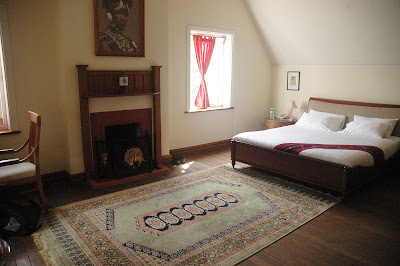 |
| they'd have lit a fire in the evenings, if we'd asked |
In the late afternoon, the sky fills with big dark clouds,
so we took giant umbrellas the hotel offered and set out for town with the
little map the hotel provided. After a short walk, the road forked and we
weren’t sure what to do. It was starting to rain, and we stood there uncertainly,
trying to decide which way to go. We stopped a man and asked which way to
Kalaw, and he indicated that both roads went to Kalaw. Then an older woman
approached us and asked if she could help us. She spoke beautiful English, and
said she’d walk with us. We weren’t expecting that, and I tried to tell her she
didn’t need to accompany us but she said she was going that way anyway, which
was confusing because she’d been coming from one of the two roads from/to Kalaw,
so why would she be going back to Kalaw? She’d earned her degree in chemistry
and had wanted to be a teacher, but she said the government didn’t provide any
jobs when she graduated so she spent her working life as a clerk in a
government office. After she retired, she started working in hotels, as a
manager. The rain came and went while we walked, and it got darker and darker.
She was very warm and friendly, and at one point she invited us to her home.
Marc and I are both very shy and socially unsure of ourselves in the best of
circumstances, but we really didn’t know what the etiquette required in this
situation, so I just said yes, thank you, that would be so nice. We were both
anxious, what would happen, would we know what to do. We got to her home and the
power was out, which she said was quite common. She lit three small candles,
the kind you’d put on a birthday cake, and asked if we’d like to see some
photographs. She brought out a couple of small albums and we looked at the
photos by birthday candlelight – photos of her six children, 5 girls and a boy,
all of whom graduated from the university. She showed us a couple of postcards
people had sent her, and then she and I exchanged names and mailing addresses.
She said her Burmese name is very complicated (Daw Khin Aye Yi), but her
English name is easy…..Janet. For some reason that cracks me up.
She suggested that we eat at a restaurant called the Seven
Sisters, so we decided to take her advice. We thought she’d just walk us to the
road and point us in the right direction, but she escorted us all the way to
the restaurant, so I invited her to eat with us, not knowing whether it was the
right thing to do. Since she’d invited us into her home, and since she’d walked
us to the restaurant, it seemed like we should, but I didn’t know if my
invitation forced her to agree, even if she didn’t want to. The mysteries of
etiquette. She ate with us, and guided us through the menu – we got three Shan
specialties, a wonderful fried minced pork dish, a fried chicken dish, and some
fish steamed in banana leaves. I kept forgetting how good her English was and
would resort to simple sentence constructions, which then sort of led me to
more superficial topics, but we also talked about politics – theirs and ours
(and she knew that it was the night of the Obama/Romney debate). She was very
bold about talking about money, asking us how much it costs to fly from New
York to Yangon, and telling us how little money she receives in her pension,
and how much she makes working as a hotel manager.
The seven sisters who own the restaurant (one has died now)
have been her friends their whole life. A younger woman brought us tea, and
Janet introduced her as the #2 daughter of sister #3. When we were looking
through Janet’s photo albums, she identified her children the same way – 2nd
daughter, 5th daughter, 3rd daughter. When we finished
eating, she asked someone at the restaurant to call us a cab. She hopped in too
and had the driver drop her off near her home. With a wave and a smile, she was
gone. It’s one of those experiences we hear other travelers talk about, and we
kind of get filled with fear and anxiety about it, but it was just fine and
something we’re very glad to have experienced. Especially in the past tense.
When we got back to our room, the hotel staff had put the
mosquito netting around our bed, so we opened all our windows and crawled into
bed for the night. I dreamed I was trapped by spider webs.
We ate breakfast at the hotel; today was American breakfast
day, so we had scrambled eggs, which was greatly disappointing. We can eat
scrambled eggs at home. After breakfast, we walked into town thinking we’d
spend some time poking through the market and seeing the town, but that took no
time so we sat in the shade and pondered our options.
 |
| here's the walk into town -- ISN'T IT GORGEOUS?! |
I had an edge of a sick
headache and the day was heating up, so we went to Sam’s Family Trekking
Service – really sweet, friendly people, and so helpful – and arranged a taxi
to take us to a couple of sites nearby. The driver pulled up in a minivan, and
I was so glad for the air conditioning. We had two destinations: a cave filled
with Buddhas, and a famous 500-year-old Buddha made of bamboo. The cave was
pretty interesting; there are three caves filled with Buddhas in Shan state,
and this one was just undergoing restoration to be open for visitors. They’d
laid ceramic tiles down the middle of the passageways, and it was very slippery
and damp. There were all kinds of electric lights strung throughout the
passages, some overhead, some fixed to individual statues, some strung along
the rocks in the cave. Some Buddhas had flashing red and blue lights behind,
like a Las Vegas roulette wheel. People left fresh flowers scattered throughout
the cave. There were little statues placed very high on little ledges and big
ones tucked away in niches, and reclining Buddhas, and Buddhas placed in
something like a monster. One little niche of the cave had a place to sit, so
Marc and I sat for a minute and a Burmese man came into the space – it seemed
like he wanted to sit and meditate, not like he was a tourist. Otherwise, we
saw a couple of girls who seemed to be tourists, taking pictures of each other
in front of the larger statues. Outside the cave were dozens of gold stupas, as
always, and a number of tableaus of Buddhas and elephants.
 |
| here is the inside of the cave -- all the photos below were taken inside, too |
 |
| and here we are outside |
 |
| religious objects placed everywhere |
After that, the driver took us to the famous bamboo Buddha;
we didn’t know what to expect, but I think we were both surprised. We’d somehow
expected it to be extremely large but it was a regular sized Buddha in a
regular pagoda, and covered in gold. Apparently it used to be black lacquer,
and then people started applying gold leaf to it. As always, only men can be
near the Buddha (Ladies Prohibited!), and the driver took Marc up to the
Buddha. It’s funny, the attitude toward the Buddha figure. On the one hand,
it’s treated with great reverence, as you’d expect. But the driver got my
attention and said kind of loudly, “listen!” and rapped sharply on it to show
me how it sounds. That took me a little by surprise. As we sat, a nun brought
us cups of tea and a little saucer of spiced nuts.
 |
| there it is, the Bamboo Buddha. That's our sweet driver in the yellow shirt, and Marc gazing at the Buddha, behind him |
On our way back to town, the driver stopped at the overlook
so we could see all of Kalaw. It’s settled into a valley, and he said the
original hill people called it Kalaw, and now we call it Kalaw. He seemed to be
sure that he was saying that differently, but it sounded the same to Marc and
me. The word ‘kalaw’ means something like cooking pot, he said, which I
imagined to be like a wok, with the town settled into the bowl of the valley.
Although we’ve been surprised by how many pine trees there are, he told us that
the government sold the rights to the Japanese to come in and cut down all the
pine trees. He said this with great bitterness – I think he said, “you know, how do you say, the dirty Japanese.” I
think he was complaining that they just clear cut everything but then took away
only the perfect straight trees, leaving the rest on the ground. He said now
you only see young pine trees.
 |
| If you enlarge this panorama shot, you'll see Kalaw, in the valley |
We’ve also been struck by the relatively large mosque and
two prominent Christian churches – one Catholic and one Baptist. We’d asked
Janet how everyone gets along and she said the Buddhists and Christians help
each other. What she didn’t say seemed notable to me, but our driver made the
point much more explicit, saying that the Muslims are, “you know, how do you
say, straight,” which I took to mean rigid. He had little positive to say about
them, filling in the silence that Janet left. He said they believe they are the
only ones with the right religion, essentially, and then he went into a kind of
beautiful discussion of samsara, of karma, saying that Buddhists believe you
can do anything you want, you can kill if you want to, but in your next life
you will suffer. If you do bad, you will get bad. If you do good, you will get
good. Do whatever you want, the consequence will be yours.
 |
| here's the mosque in Kalaw |
 |
| and, of course, monks! Usually they walk, but these had wheels. |
After a quick lunch in the market, we returned to our room
for the hot part of the afternoon, and then walked into town for our dinner at
the Everest Nepali Indian restaurant. It received the highest ratings in the
TripAdvisor forums, and in Lonely Planet, and it really was wonderful. The
woman we interacted with was beautiful, and spoke warm and friendly English. My
bottle of Myanmar beer kicked the last bits of my headache away.
When I think of Kalaw, I’ll think of the brilliant orange
flowers and purple morning glories that are everywhere and always next to each
other. I’ll think of the shock of pine trees next to palm trees. I’ll think of
Janet. I’ll think of the essential oddness of our hotel, and how it felt like
we were on a vacation away from Myanmar.
 |
| these are the colors of Kalaw |


